










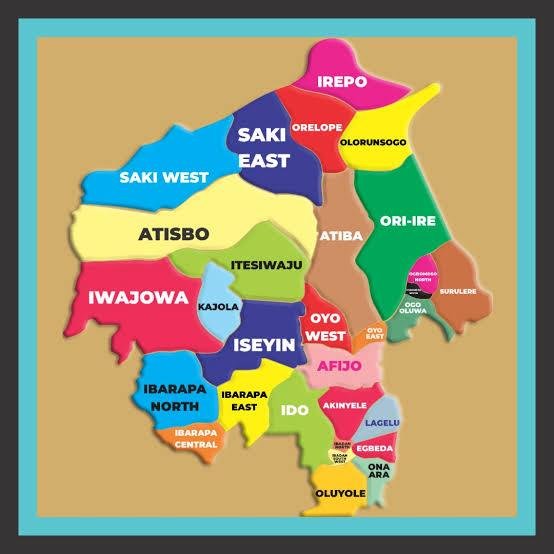


The focus of my article today is the price of regional division in the struggle for Ọ̀yọ́ State Governorship and I like to start by saying that, in the heart of Ọ̀yọ̀ State lies Òkèògùn, a region blessed with rich culture, fertile land, vast population, and undeniable intellectual capital.
From Ṣakí to Ìṣẹ́yìn, from Kìṣí to Ìgbẹ́tì, from Òkehò to Igboho, and all the vibrant towns and villages in between, Òkèògùn boasts of a people whose collective strength, if harnessed, could redefine political leadership in Ọ̀yọ́ State. Yet, despite these natural advantages, Òkèògùn remains a political bystander in the quest for the governorship seat, not because it lacks the quality or quantity of leaders, but because it is tragically divided against itself.

There is big wound within us that we must do all to heal. Rather than closing ranks and forging a common front, the sons and daughters of Òkèògùn have become their own worst enemies as we divided by ego, crippled by rivalry, and distracted by fleeting personal interests.
In every election cycle, we fragment our votes across multiple aspirants, each backed by micro-zones, family loyalties, or godfathers with conflicting ambitions. Some even offer themselves cheaply to political parties as loyal stooges and pawns in a wider game orchestrated by hegemonic forces that see Òkèògùn only as a voting bloc to be manipulated, never as a contender to be respected.
While Ibadan continues to consolidate its grip on the political soul of Ọ̀yọ́ State, often dominating appointments and governorship candidacies, Òkèògùn is trapped in internal competition, envy, and sabotage. Instead of speaking with one voice, it echoes with many tongues, each pulling in a different direction, weakening the collective bargaining power of the region and giving external forces the leverage to divide and rule.
It is clear that there is an external exploitation and it is no secret that many power-brokers outside Òkèògùn have studied this division and perfected the art of exploiting it. Some dangle promises of Deputy Governorship and Party Chairman. While some offer senatorial tickets, others sprinkle appointments like bread-crumbs just to pacify and divide.
Sadly, many of Òkèògùn’s so-called leaders fall for these political tokens, preferring crumbs from the master’s table to the challenge of building their own. They mortgage the future of their people for short-term gain, forgetting that until Òkèògùn rises as a united political force, it will continue to be marginalised in the larger scheme of state politics.
We have good examples of missed opportunities that our disunity has caused our region. Over the past two decades, opportunities have come and gone. Apart from the lost of State Creation a few years ago, there were times when Òkèògùn stood on the brink of history, with sons and daughters close to clinching party tickets; but, again, internal division, last-minute betrayals, and lack of strategic alliances turned dreams into dust.
Meanwhile, other zones with less population and fewer resources have been speaking with one voice in unity of purpose to get things done. Other zones, instead of rising agajnst one another, have continued to rotate the seat of power because they understand unity, long-term planning, and strategic negotiation.
This article is nothing but a call to conscience. It is not to cast blame, but to call attention. It is a trumpet of warning to the elite, the youth, the traditional rulers, the political class, and the grassroots of Òkèògùn. If we do not learn to rally behind one vision, if we continue to allow envy, selfishness, and external manipulation to divide us, then we have chosen voluntary slavery over political emancipation. One thing I like us to know is that the governorship seat will not fall like manna from the sky. It must be pursued with unity, strategy, and courage.
We need town hall meetings, regional caucuses, intellectual debates, and traditional consultations to forge a united front. We need a Charter of Unity that every serious aspirant from Òkèògùn must sign where he or she will pledge not to divide the house, but to step down for the most acceptable and strategically positioned candidate.
In other word, we must not only prepare to vote; we must prepare to negotiate, mobilise, and assert.
Here is Story I remember that best illustrate the message I’m trying to pass across to us. There was a town where the river that served the whole community was drying up. The elders called for a meeting to solve the water crisis. But rather than unite, each clan dug its own shallow well beside the river, hoping to survive alone. None of the wells reached water. Meanwhile, a smaller neighbouring village worked together to build a dam upstream and channelled water to their farms and homes. The once prosperous town that refused to unite slowly turned to dust, watching helplessly as the smaller village they once despised became a centre of attraction.
So too will Òkèògùn remain if it refuses to unite, it will continue to thirst for power while others drink from the stream of leadership.
My final word to all of us is to challenge by telling us that there is no better time to rise up than now. The time is now. The winds of political change are blowing again. Let Òkèògùn not be found asleep at the wheel. Let us rise above petty differences. Let us choose unity over ego. Let us show the world that Òkèògùn is not just a region rich in land and people, but in wisdom and strategy.
For if we do not hang together, we shall, most certainly, hang separately.
Òkèògùn, rise!
Unite!
And, take your place!
Pst. Favour Adéwọyin,
A public analyst, social critic, writer, journalist, public relation manager, youth manager, leadership expert, teacher of the word of God and community leader._