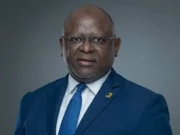



















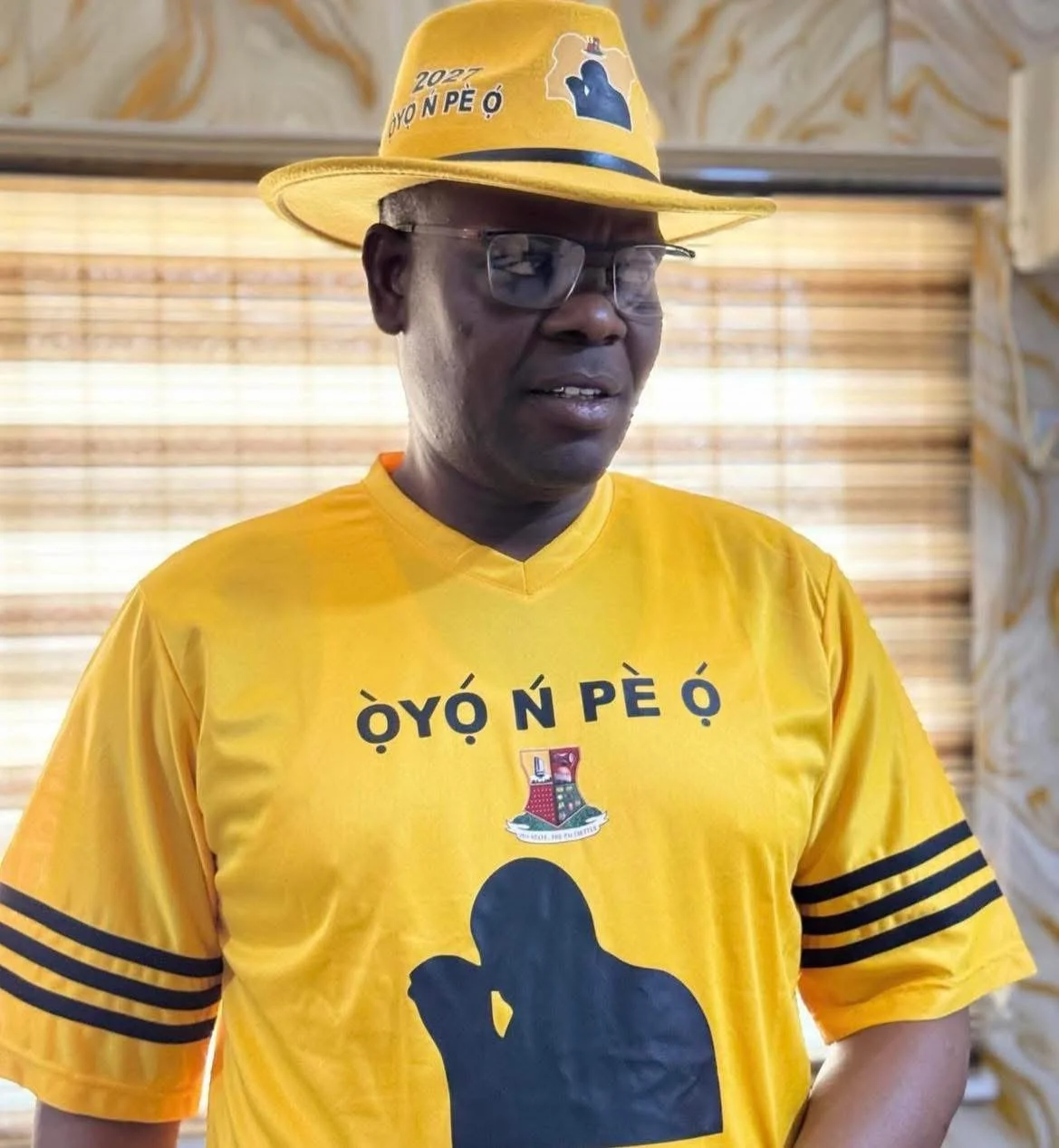


When a friend casually threw the question at me, “Is the ‘Oyo n pe o’ cry genuinely the heart-cry of the people, or is it a calculated political script written by Oriyomi Hamzat himself?” I did not hear idle curiosity. I heard the sound of Oyo State standing at a crossroads. It was the kind of question that captures the mood of early 2026, a moment thick with expectation, suspicion, hope, and a growing impatience with the old rhythms of power. It is also the question that best frames the sudden but consequential entry of Oriyomi Hamzat into the 2027 governorship race under the Accord Party.

This is not merely about one man’s ambition. It is about how influence is built in modern Oyo politics, how emotions are mobilised, and how the line between people-powered movements and personal political calculation has become increasingly blurred. Oriyomi Hamzat, broadcaster, activist, media owner, and now governorship aspirant, sits at the centre of this tension. To understand whether he is a populist answering a genuine call or an opportunist seizing a moment, one must first understand the long road that brought him here.
Oriyomi Abdulrahman Hamzat’s story is inseparable from the media.
As expected, he was born and raised in Ibadan. He grew up around journalism; his father worked with the Nigerian Television Authority, and that early exposure shaped his worldview. Although trained academically outside politics, Hamzat gravitated naturally toward broadcasting and advocacy. He worked across notable media institutions, including The Guardian, the Broadcast Corporation of Oyo State, and the Federal Radio Corporation of Nigeria, among others. These years did more than build his résumé; they taught him how narratives are shaped, how power reacts to scrutiny, and how ordinary people respond when they finally feel heard.
That knowledge culminated in 2021 with the founding of Agidigbo 88.7 FM, a radio station deliberately designed to sound unlike the polished, elite-friendly stations that dominate urban Nigeria. Broadcasting largely in Yoruba and branding itself as “the people’s voice,” Agidigbo FM became a space where grievances were not sanitised. Everyday injustices, local disputes, cases of alleged oppression, and frustrations with government found room on the air. Hamzat did not just host programmes; he curated outrage, empathy, and solidarity. In a state where many citizens feel alienated from decision-makers, that mattered.
True, programmes like Kokoro Alate transformed Hamzat from a broadcaster into a public actor. He mediated disputes, pressured authorities, and often inserted himself directly into social conflicts. Over time, listeners stopped seeing him as a journalist and began seeing him as an advocate, sometimes even a protector. Trust followed, and with trust came loyalty. But influence of that magnitude rarely exists without friction.
If you remember very well, under the administration of late Governor Abiola Ajimobi, Hamzat’s confrontational broadcasting style drew the ire of authorities. There were moments when Agidigbo’s equipment was seized, and periods when Hamzat himself was arrested and detained over broadcasts deemed inciting or confrontational. These encounters with state power, particularly his detention and questioning by security agencies, became part of his mythology. To supporters, they were proof that he was paying a price for speaking truth to power. To critics, they were evidence that he often pushed the boundaries of responsible broadcasting. Either way, those episodes hardened his image as a man willing to confront authority and endure consequences.
Ironically, his relationship with power softened with the emergence of Governor Seyi Makinde in 2019. For years, Hamzat and the Makinde administration enjoyed what could best be described as a functional, sometimes cordial relationship. Agidigbo FM was publicly acknowledged by the government for its reach and youth engagement, and Hamzat himself was often seen as a sympathetic voice to some of Makinde’s reform narratives, even when critical. This relative harmony reinforced the perception that Hamzat was not anti-government by default, but anti-injustice by instinct.
That complexity resurfaced sharply in December 2024, after the tragic stampede in Ibadan that claimed the lives of more than 30 children during a charity event. Hamzat, among others, was arrested and remanded as investigations commenced. The incident shook public confidence and briefly placed him on the defensive. When the Oyo state government later withdrew the charges, reactions were mixed.
Supporters saw it as another instance of Hamzat being unfairly targeted before justice prevailed. Critics interpreted it as evidence of his proximity to power and questioned whether accountability was selectively applied. What was clear, however, was that his relationship with the Makinde administration had entered a more strained and complicated phase.
It was against this backdrop that Oriyomi Hamzat made the most consequential decision of his public life, his formal declaration to contest the 2027 Oyo state governorship election under the Accord Party. At a well-attended event in Ibadan, he ended years of political ambiguity. No longer just the voice interrogating power, he stepped forward as one seeking to wield it. The chant “Oyo n pe o,” which had floated for months as a cultural and political whisper, was now fully owned as a campaign signal.
In his declaration, Hamzat framed his ambition as reluctant obedience to public demand rather than personal desire. He spoke of years of listening, intervening, and witnessing the limits of advocacy without authority. He told supporters he would no longer mobilise crowds for other politicians, insisting that the moment had come to translate voice into action and sentiment into policy. It was a speech heavy with moral framing, leadership as duty, ambition as service, and power as responsibility.
This framing explains why many see him as a populist in the classical sense. Hamzat speaks the language of “the people” versus “the system.” His appeal is emotional, intimate, and rooted in shared frustration. He does not present himself as an elite problem-solver but as a product of collective suffering and hope. “Oyo n pe o” works precisely because it suggests that power flows upward from the people, not downward from party structures. In an era of elite fatigue, that message is potent.
However, this is also where the opportunism critique becomes unavoidable and central. Critics argue that Hamzat’s populism is not accidental but cultivated. Years of controlling a powerful microphone, shaping narratives, foming fan base in wards structure and positioning himself as moral referee created a ready-made base for political conversion. To them, his move into partisan politics is less a response to public demand and more the logical harvesting of influence patiently built.
They question whether his interventions were always altruistic or whether they doubled as long-term political investments.
More fundamentally, sceptics worry about the gulf between emotional mobilisation and administrative competence. Running a radio station, mediating disputes, and amplifying outrage are not the same as running ministries, managing budgets, or navigating federal-state relations. Oyo State is a complex political and economic organism. Critics fear that Hamzat’s greatest strength, his emotional connection with the masses, may become his weakest point if it crowds out policy depth, institutional discipline, and technocratic rigour.
Now, Hamzat’s own words often blur this line further. When critics warn that popularity does not equal electability or capacity, he responds with unapologetic confidence. His insistence that he will contest and win, dismissing conventional political calculations, reflects both populist defiance and strategic audacity. It is confidence that energises supporters and unsettles opponents, while simultaneously raising questions about humility and preparedness.
Comparisons with figures like Peter Obi and Seyi Makinde are inevitable. Like Obi, Hamzat channels anti-establishment sentiment and relies heavily on moral persuasion rather than party machinery. Like Makinde, he represents a non-traditional pathway into power, proving that influence can precede office. But there is a crucial difference: Obi and Makinde entered their defining races with clearer ideological and policy scaffolding. Hamzat’s ideology is still forming in public view.
Which leads to the unavoidable question: Does Oriyomi Hamzat have the capacity to govern Oyo state? His supporters insist that empathy, courage, and listening, qualities he has demonstrated consistently, are the foundation of good leadership. They argue that technocrats can be hired, but trust cannot. His critics counter that without tested administrative experience, empathy risks becoming symbolism rather than a solution.
What is beyond dispute is that his entry has altered Oyo’s political terrain. Established politicians are now forced to contend with a candidate whose power is not rooted in godfathers or war chests, but in years of emotional proximity to the electorate. Campaigns will no longer be fought solely in party offices; they will be fought in narratives, on airwaves, and in public memory.
In the end, the Oriyomi Hamzat question resists a binary answer. He is neither purely a populist nor merely an opportunist. He is a product of his time, a symbol of how media power, emotional politics, and public disillusionment converge in contemporary Nigerian democracy. Whether he ultimately becomes a transformational leader or a cautionary tale will depend not on chants or slogans, but on substance, structure, and restraint.
Ogungbile Emmanuel Oludotun can be contacted via thedreamchaser65@gmail.com