
















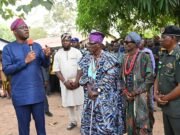


Ibadan is set to witness a historic moment as former Oyo State Governor Rashidi Ladoja is installed as the 44th Olubadan of Ibadanland. The event, scheduled for Friday, 26 September at Mapo Hall, will be graced by dignitaries across Nigeria, including top government officials and politicians.
But beyond the anticipated fanfare, mounting the Olubadan stool, which is more than two centuries old, signifies more than the crowning of a new traditional ruler. The coronation is the story of a city that forged its identity through war and resilience, and of a unique succession system that rewards patience and seniority rather than just birthright.


The ladder system explained
In many kingdoms, the throne passes within a royal family lineage. When a king dies, the kingmakers choose his successor from eligible princes of a suitable ruling house. That is how traditional rulers like the Ooni of Ife, the Alaafin of Oyo, the Emir of Kano, the Sultan of Sokoto, among others, are selected. In other places, like the Benin kingdom, the crown passes from father to son.
The tradition of choosing the next king from among the princes of ruling houses involves rotating the crown among different royal houses, preventing dominance by one family. In this instance, the kingmakers select from the house whose turn it is.
The Ibadan system is unique because the Olubadan stool is not passed from father to son or rotated among ruling houses. Instead, every Ibadan son can become an Olubadan through either parallel lines of the Otun (civil) line or the Balogun (warrior) line that take turns to produce the Olubadans.
The potential Olubadan starts as a Mogaji, or family head, and climbs the hierarchy of chiefs. Death creates room for elevation up the line, so he moves one step closer to the throne with every passage on his line. That is why the Ibadans are called “Agbotikuyo”; they are people elated by the news of death. It is a marathon race to the throne, often taking decades. However, any Mogaji can hope to become the Olubadan, regardless of wealth or family name.

This unique arrangement reflects Ibadan’s origins. Founded in the 19th century as a war camp, the city grew into a republic of warriors who valued seniority, discipline, and collective decision-making over hereditary privilege. In that spirit, the Olubadan stool has never been about bloodline but service and perseverance.
Lines of succession
Chieftaincy promotion to the Olubadan stool is along the Balogun and the Otun lines. According to the website, olubadan.com, an online resource hub on Olubadan, each line comprises several chieftaincy titles, and candidates must progress through these titles before becoming eligible for the Olubadan throne.
“This system ensures that the title of Olubadan is open to every male indigene of Ibadan, provided they ascend through the established hierarchy. The Olubadan succession is based on two main ruling lines, each with a distinct hierarchical ladder,” the website stated.
Becoming Olubadan is never a sudden rise. Every occupant of the throne patiently climbed the traditional ladder of titles, one promotion at a time. Those on the civil line face 22 stages before they can wear the crown, while those on the military (Balogun) line must scale 23 titles, beginning at the lowest rung of Jagun Balogun.

The succession system also has notable drawbacks. The long years of waiting often mean that a chief who finally ascends the Olubadan throne is advanced in age. Oba Samuel Odugade I was crowned in my 90s, while many reigned for only a few years before passing on. In fact, many chiefs never live long enough to reach the Olubadan stool.
The late Oba Owolabi Olakulehin, who ascended the throne as the 43rd Olubadan barely a year ago, was from the military line of succession. His demise means Mr Ladoja, the Otun Olubadan and first on the civil line, becomes the automatic choice for the throne.
Rashidi Ladoja’s path to the throne
Mr Ladoja’s climb began in the 1980s when he was installed as Mogaji of the Odugade family compound.
On 1 October 1993, he became Jagun Olubadan, rising to the rank of the Osi of Olubadan by 2017. On 4 March 2024, he became the Otun Olubadan, the highest-ranking position on the civil line. That rank placed him next in line to the throne after Oba Olakulehin, the 43rd Olubadan.
When Oba Olakulehin died in July, the Olubadan-in-Council nominated Mr Ladoja as the 44th Olubadan of Ibadanland, a choice later ratified by the Oyo State Government.
Ahead of his installation on 26 September, he has received goodwill messages and courtesy visits from top dignitaries, political officeholders, and community leaders.
The visits, which have come from within and outside Oyo State, underscore the significance of the Olubadan stool beyond Ibadan.