









To confront what they termed as a deliberate political backsliding, FCT Minister, Nyesom Wike, himself a defeated Presidential hopeful, once assembled a band of loyal PDP Governors to checkmate the former Vice President, Alhaji Atiku Abubakar from becoming Nigeria’s sixteenth head of state – in the 2023 Presidential election.
To win public support and sympathy, the G-5, alongside their strategists and media partners carefully curated several sensational and hypnotic narratives that captured the core of their messages in plain, crystal clear and concise punchlines: a northerner, late Muhammadu Buhari has ruled the country for eight solid years, and allowing another northerner, Atiku Abubakar to take over from his northern brother would fracture the very foundation upon which the unity, stability and diversity of Nigeria rest.

That message stuck partly because Nyesom Wike’s supremely masterful move against the reactive and often pitiful Atiku’s came as both strategic, calculative and disruptive. As the Governor of the oil-rich Rivers State, Nyesom Wike sat atop an enormous petrol-dollar and a voting bloc that is indispensable for any Presidential candidate. But he was never alone. In the southwest of the country, the region with the second largest registered voters, Wike had Seyi Makinde firmly planted as a loyal lieutenant and a closed ally. In Benue, the state that had struggled with insecurity under Buhari, Ortom stood as a lone voice, energized by the nationwide acceptability of his group. In the southeast, the presence of Okeize Ikpeazu of Abia and Ifeanyi Ugwuanyi of Enugu completed the once dominant Group of 5 PDP governors committed to ensuring the nation’s fragile unity is sustained.
Outside looking in, the G-5 governors enjoyed public support and applause especially in the southern part of the country where power rotation was considered a sacred and unbroken pact that hold the country together. Indeed, the group commanded huge respect in all the 17 southern states and had positive and glowing things said about them in the media – not because of who they are but because of the course they championed – power rotation to the south or nothing.
Not surprisingly, in the north east and west, G-5 were considered party traitors, tribal bigots, regional villains and political saboteurs. Of course, the discerning members of the public knew too well that the simplistic interpretation of that whole drama by a section of the country was utterly faulty. While Atiku was determined to stamp his feet on the sand of time by snatching party ticket regardless of whose ox is gored, Wike and his group were only after their eternal political survival and relevance – especially once they are kicked out of power. The fight between the two political camps therefore shows the perils and pitfalls of placing personal interests about collective aspirations
In that period of heightened political tension, Wike rose from the brash governor of Rivers State to a vocal, unsparing and combative voice on the national stage. He left no stone unturned on what he believed to be the ultimate political truth. He used his power, resources and influence to ensure PDP and Atiku had their wings clipped and influences reduced. But he was not the only one who spoke strongly against the ‘northernization’ of the PDP. Seyi Makinde, the soft-spoken introverted Governor of Oyo State equally landed several devastating blows on both the PDP and Atiku especially when public pressure increased over his preferred Presidential candidate.
In one daring and glaring public statement for instance, Makinde through his deputy, Bayo Lawal subtly remarked that “Since he (Makinde) has become a governor, he hasn’t played with issues concerning Yorubaland”. He added that the Governor has followed the step of the Afenifere leader, Pa Reuben Fasoranti “by supporting whoever Fasoranti supported’. Fasoranti was supporting Tinubu in that race.
By the time the election eventually holds, the G-5 except Sam Ortom had thrown their weight behind the All-Progressives Congress Presidential candidate, Asiwaju Bola Ahmed Tinubu. After a charged and contentious collation of results, on Wednesday, March 1, 2023 the Independent National Electoral Commission, INEC, Chairman Professor Mahmud Yakubu declared Asiwaju Bola Ahmed Tinubu as the winner of the contest. Of truth, that declaration effectively marked the end of the political activism of the G-5, at least on paper. Not bounded by any unified advocacy, the group’s descent into disintegration and irrelevance began in earnest.
The quiet disintegration of the G-5 is a public knowledge. Apart from Seyi Makinde who was seeking re-election in 2023, others such as Nyesom Wike, Sam Ortom, Okezie Ikpeazu and Ifeanyi Ugwanyi were second term governors marking their final days in office. For Makinde, the future was crystal clear: win second term and cement your legacy as a serious political gladiator. For Wike, the next chapter of his political life required intense lobbying and horse-trading. But as a skilled negotiator, he got himself a juicy ministerial slot while the duo of Ikpeazu and Ugwuanyi recently secured ambassadorial nominations for themselves. For Ortom, his choice of Peter Obi instead of Tinubu has cost him a seat at the table of current power brokers and decision makers.
For his re-election, Makinde was backed by those that matters. He won by a historic landslide. To cement his goodwill with President Tinubu, GSM made several trips to Abuja, hoping to get the Oyo State ministerial slot for one of his boys. In one of such trips, journalists even asked about his frequent visits to the State House to which he sarcastically responded “should I visit Yola (Atiku’s base) instead of Abuja where deals are cut and resources are shared. Despite those trips to Abuja, Oloye Bayo Adelabu eventually beat the Governor at his own game.
From that moment on, GSM hasn’t relented in his attacks of the government he helps installed. He has called the Tinubu’s government and its numerous policies many unprintable names. Recently, he condemned the government for stifling critics, dissents and oppositions.
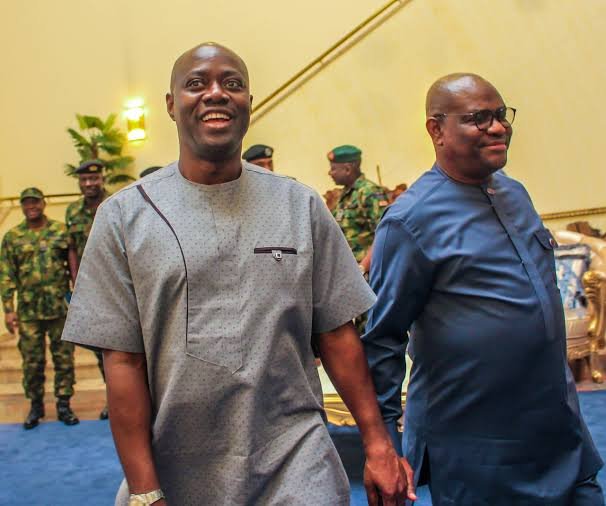
Of course, all of those attacks and criticisms while Wike, his estranged brother, continued to serve as a minister with his affiliation to the People’s Democratic Party intact. Wike’s decision to stick with the umbrella while serving under the broom became the last straw that broke the Carmel’s neck effectively bringing Makinde and Wike on a collision course. Makinde, the only serving PDP governor in the southwest is desperate to control the affairs of the party from Ibadan while Wike, once the biggest financier of the party is unbothered about holding down the party for his own interest. And all hell broke loose.
The inability of Nyesom Wike and Seyi Makinde to sort out their differences, reach a common ground and resolve whatever grievances has finally nail the coffin of the PDP in a way that party may not survive.
Today, the PDP, under whose 5-G became notoriously popular has become an unrecognisable political party: deeply divided, largely unpopular and structurally weak. No doubt, the clandestine poaching of its Governors by the APC hasn’t helped matter; neither has the numerous legal fisticuffs tearing the party into a tiny shred. In sum, what started as a promising political group has now turned into an abandon shipwreck!
Wale Oladigbolu writes about power, politics, policy, governance and everything in between about Oyo State.