

















For far too long, political discourse in Nigeria has been disproportionately centralised. It is understandable, given that the federal government controls numerous functions that should rightly belong to the states. Public debates often revolve around the president, the National Assembly, or federal agencies, while state governments quietly mismanage billions, evade accountability, and fall short in performance. Meanwhile, these very states hold the constitutional mandate for the services that most directly affect citizens’ daily lives: primary education, healthcare, infrastructure, local security, and job creation. That’swhy we must elevate the quality of public discourse at the state level—and break free from the cycle of shallow elite politics that has kept meaningful progress out of reach where it’s most needed.
As a matter of principle, I have long advocated for restructuring, fiscal federalism, and a system that allows states to truly chart their destinies. However, restructuring is not an end in itself—it is merely the beginning. With the growing autonomy already evident in sectors like energy and rail, the real task ahead is holding state governments accountable. The pressing question is no longer, ‘What should Abuja relinquish?’ but rather, ‘What are the states doing with the powers they’ve already gained?’

I once argued in a debate that subnational governments in Nigeria have not exactly inspired much public confidence. With the autonomy and federal allocations they currently enjoy, we should be seeing bold, experimental development blueprints—visions of what full regional or state-led governance could achieve. Without that ambition, the promise of restructuring remains hollow. To be honest, only Lagos and Rivers States have demonstrated real promise so far, and that can be largely attributed to their robust Internally Generated Revenue (IGR) base, which gives them the fiscal space to invest in infrastructure, education, health, and public services without overreliance on federal allocations.
We cannot champion federalism only when it is convenient, while falling silent when governors shirk their duties, like refusing to publish audited budgets, neglect public schools, squander borrowed funds on vanity projects, or simply fail to perform their constitutional roles. True federalism is not merely about devolving power; it is ultimately about ensuring accountability and responsibility are brought closer to the people.
This prompts a closer look at Oyo State, particularly in light of the ₦63 billion government house renovation controversy. While this article does not seek to pass judgment on that expenditure, we must engage in a broader discussion about our priorities.
While Oyo State, like many others across the federation, faces undeniable resource constraints, the more persistent deficit over the past 34 years has been one of vision. We often lack a coherent, long-term plan that outlasts election cycles and endures beyond the rise and fall of administrations. A vision that sees governance not as a reward for political victory, but as a solemn duty owed to our generations yet unborn. One that regards the people of Oyo not merely as voters to be rallied, but as co-architects of our shared future.
Too many of our leaders have governed in election cycles rather than in decades. They have ruled with urgency for headlines, but not with commitment to legacy. However, without a structured, forward-looking development agenda, even good intentions become lost in the noise of politics. We cannot keep blaming Abuja for what is essentially a failure of state-level imagination and discipline. The next chapter of Oyo’s development must be intentional. It must begin with a hard question: where exactly are we going as a state? Because without that clarity, we will keep spinning in place, building, demolishing, recycling, but never truly transforming.
Short-termism has cost Oyo State more than any single budget deficit ever could. You see it in Ibadan, a city once heralded as the intellectual capital of West Africa, now grappling with erratic infrastructure, chaotic urban planning, and a crumbling sense of order. In our basic education sector, reforms are often launched with great fanfare—only to be quietly discarded when a new administration assumes office. Meanwhile, our healthcare system remains overstretched; rural communities continue to be isolated by inadequate road networks; and countless industrial-scale projects are initiated, only to be abandoned before completion, and left to deteriorate without impact. With every new government comes a new slogan, a fresh ‘strategic framework,’ or a glossy master plan—yet rarely do policies survive beyond their initiator. Institutions meant to guide long-term development are either politicised or left to wither from neglect. Continuity is mistaken for weakness, and as a result, progress is repeatedly derailed. However, this is not just inefficiency—it is a betrayal. Because every time a promising initiative is shelved for political convenience, it is the people, not the politicians, who pay the price.
If we are going to break this cycle, the people of Oyo must stop being treated as spectators. Governance must move from spectacle to substance — and from patronage to partnership. The average citizen in Oyo today is disengaged from the budgeting process, unaware of long-term state planning (if it even exists), and uninformed about how priorities are set. This is not their fault; it is by design. Politicians often prefer a disengaged public because apathy gives room for unaccountable governance. However, real development is participatory. It requires civic inclusion, active town hall forums, and citizen review of major projects. It requires transparency, not just in procurement, but also in policy direction. If a governor inherits a project worth billions, the people deserve to know whether it will be completed, modified, or abandoned — and why. A government that fears public input cannot deliver public progress. We must build a new culture in Oyo State where leaders do not just campaign with the people, but govern with them.
This is said with no disrespect to those who have governed during that period, especially the post-1999 democratic era. My core argument remains: the state must never become a personal project for any governor. Governance should not be subject to the whims and caprices of whoever holds office at a given time. Oyo State deserves a steady, institutional vision that transcends individual ambition and political cycles.
Vision is not a buzzword; it is a blueprint. And blueprints must be detailed, data-driven, and built to outlive any political administration. If Oyo State is to escape its cycle of stagnation, then the political class, business community, technocrats, corporate leaders, diaspora professionals, senior civil servants, traditional rulers, and civil society must come together to shape a 25- to 50-year development strategy. Not from scratch, but by building upon what already exists. Oyo State has produced planning documents in the past, but like in many parts of Nigeria, they often end up in drawers, ignored by successive administrations. That must change. The existing frameworks must be revisited, revised to reflect today’s economic realities, demographic trends, climate pressures, technological shifts, energy needs, rail infrastructure, and urban planning goals. More importantly, these plans must transcend political manifestos to become guiding doctrine for governance, regardless of who holds office.
This development plan must be enshrined in law, widely disseminated, and subject to continuous public oversight. It should outline clear, measurable benchmarks across key sectors—education, urban infrastructure, agriculture, industrial policy, healthcare, and inter-state or regional trade. More than just a vision, it must inform our budget priorities, shape industrial strategies, steer investment narratives, and serve as the definitive performance scorecard for every administration, regardless of party or personality.
Lagos stands as a proof of concept. While imperfect, its greatest strength lies in the continuity of its development agenda—from the Tinubu years through BRF, Ambode and now, Sanwo-Olu. That consistency did not happen by chance; it was forgedthrough elite consensus and a deliberate institutional commitment to a shared vision. Oyo State has every reason to chart a similar course. The intellectual capital exists. The talent pool is here, and more can be attracted. What appears to be lacking is the political will to transcend partisan cycles and commit to a long-term development agenda for the collective good.
For any long-term plan to succeed, it must be grounded in a political culture that prioritises continuity over ego and substance over spectacle. This is where Oyo’s political leadership must evolve. No new administration should feel compelled to tear down what came before just to make its mark. Campaign narratives must shift from promises of the ‘new’ to pledges of completion, consolidation, and continuity. Finishing a predecessor’s work should be politically rewarding, not perceived as a liability. This shift will only happen when citizens begin to value tangible outcomes over shallow optics, and when the political elite start viewing governance not as a platform for personal legacy, but as a relay—where progress is passedforward with care and conviction.
The Oyo State House of Assembly has a vital role to play. It can enact key elements of the development blueprint into binding legislation, while also instituting performance audits and midterm reviews tied to that vision. Civil society, the media, and traditional rulers must also apply sustained pressure so that governors are judged not just by how well they perform politically, but by how meaningfully they advance the long-term growth of the state. In Oyo, vision must become the new political currency, and consistency, its highest value.
Oyo State is not lacking in potential. We have the people, the land, the talent, the legacy, and the intellectual capital to lead Nigeria in subnational development. But doing so requires a pivot from reactive governance to intentional statecraft. It begins with a vision—one that is collectively owned, consistently maintained, and courageously pursued. A vision that outlasts party lines, personal egos, and political transitions. A vision that gives every child in Oyo State—whether in Ibadan, Oyo, Oke-Ogun, Ogbomoso, or Ibarapa—a reason to believe they belong to a state that is truly going somewhere.
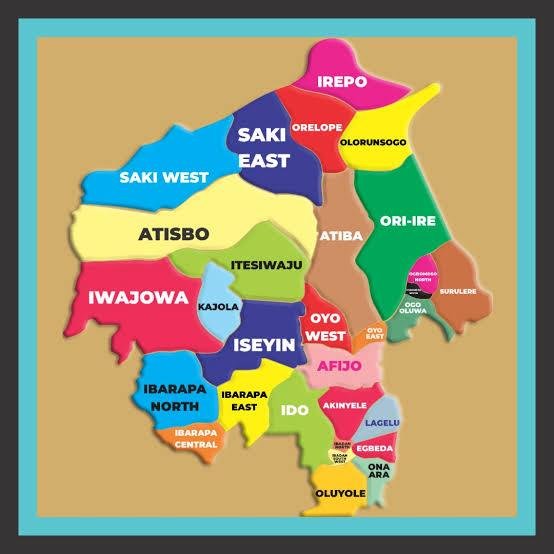
If we are truly committed to restructuring and we truly believe in federalism, then we must hold our states to a higher standard. More autonomy must come with more accountability. More control must come with more competence. Oyo State has the potential to lead, not just in voter turnout or party politics, but also in purposeful, transformative development. Let our leaders govern with maps, not mirrors. The time has come for our leaders to govern not by looking in the mirror for affirmation, but by studying our map with vision and intent. Together, we can make Oyo the state that charts a path others aspire to follow.
Ademola can be reached via +234703265 9128